Growing Forests from the Ground Up: How One Cooperative Reframed Reforestation
For years, the members of Magsaysay Marketing Cooperative (MMC) witnessed the familiar struggles of community reforestation. The pattern was always the same—grand launches, enthusiastic tree planting, then a slow but steady decline. Areas that should have been thriving forests became abandoned.
When asked why this was the case, Mr. Teodoro Rudaje, MMC chairperson, said that despite farmers’ genuine commitment, maintaining large forest areas remains challenging. The system and approach did not work with small-scale farmers like them. Previous projects were rigid—assigning large hectares of land for each farmer, while following a standard timeline and procedure meant that farmers struggled to keep up with maintenance needs.
“Dugay ang bayad,” Mr. Rudaje recalls, describing how the timing of payments sometimes made it more challenging to hire labor for maintenance when it was most needed. When resources arrived later than expected, the pace of weeding and tree care became difficult, and some seedlings suffered.
The community had land and commitment. What they needed was an approach that could work more closely with the daily realities of small-scale farmers without compromising their farming activities and their dignified living.
A Complementary Partnership
When Nature’s Spring Foundation Inc. (NSFI) partnered with the cooperative in 2023 through the WATER Reforestation Project, it introduced an approach designed with flexibility and close community engagement. Listening to the farmers’ needs became part of the system, ensuring that challenges in project implementation are addressed as the project progresses.
NSFI follows a batched implementation approach rather than working across large areas immediately. Each year means a new batch of total hectares planted, but before that is implemented, annual consultations are held with partner People’s Organizations to discuss and agree on the size of manageable forest area plots. Annually, 10 hectares of forest land are adopted, under which NSFI funds MMC to produce, plant, maintain, and protect fruit, native, and indigenous tree seedlings.
MMC also implemented an innovative management approach to complement the partnership. The adopted forest sites were not managed solely by the board, officers, and working committees. Instead, they allowed members to adopt smaller, manageable plots of 1-2 hectares in size. They adopted a role-modeling approach where the most dedicated and experienced farmers were piloted first, serving as role models to inspire others to maintain the tree seedlings well. The logic was simple but powerful—let success breed success.
“Ang tanom ma atiman jud kay gi una sila og paghatag og budget,” Rudaje explains. The crops were maintained because they first invested in the early adopters who would not neglect the project and who have the potential to guide other members in effective forest management.
The cooperative set clear criteria for those interested in joining: cooperative members, those who have managed forestlands, and those who can vouch for their hard work protecting forestlands. Those with experience came first, and others saw how well things worked.
What Made the Difference
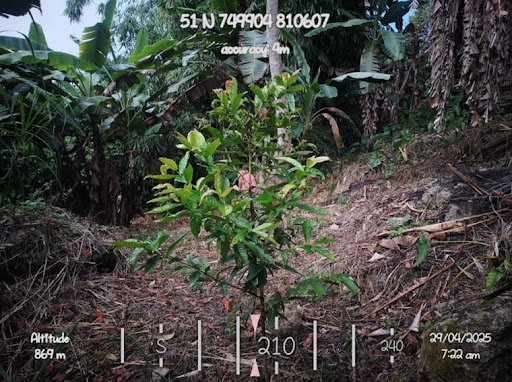
Several factors have contributed to MMC’s consistently high survival rate. Batch 1 achieved 92% and Batch 2 reached 83%, for a total of 87.5%.
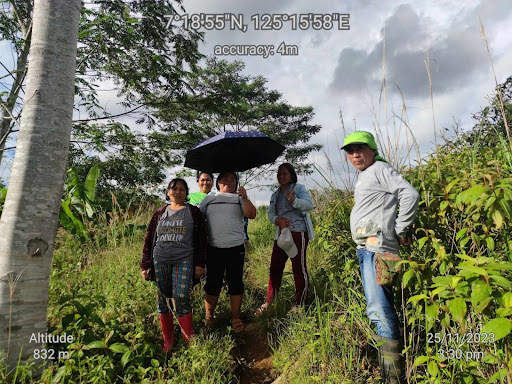
The beneficiaries themselves serve as guides during monitoring, facilitating clear communication and enabling active problem-solving. The strong organizational foundation also played a role. During the project implementation review in June of 2025, the leaders noted that unity among members is maintained, regular meetings are held to provide updates on project progress, and project concerns are addressed as they arise. They mentioned a strong commitment to the crops, especially with the integration of agroforestry crops such as Cacao, Durian, and Lipote.
NSFI, through its Forester, has provided regular monitoring and recommendations to support partner POs like MMC on which areas need attention, maintenance, and protection strategies, and how to improve soil health. The Department of Environment and Natural Resources (DENR), as key stakeholder and project partner, has also supported MMC with fertilizers and additional technical guidance.
Beyond Reforestation
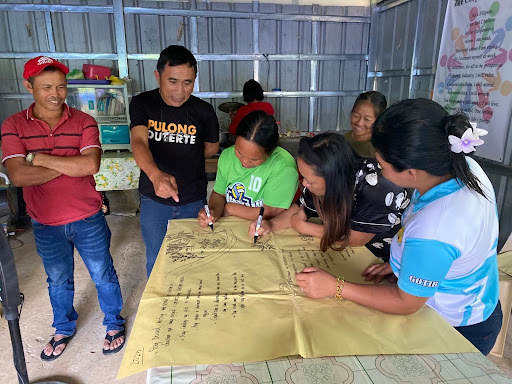
MMC’s project journey was not merely a walk in the park. It encountered several setbacks that challenged their capacity to implement projects. In a series of capacity-building workshops for partner POs, which includes MMC, Mr. Rudaje shared how important it was for NSFI and their organization to implement regular feedback to support not only reforestation management but also organizational development.
Workshops such as risk management and the fundamentals of stakeholder and resource mapping were conducted this year by NSFI to its partner People’s Organizations, which helped strengthen the organization’s capacity for planning and decision-making for future programs and projects.
“Diha pud namo na-realize nga daghan mi nakalimtan na process (kabahin sa pagpalambo sa among organisasyon). Diha pud mi nakahibalo nga ang disaster, di diay siya natural lang na mahitabo. Kay moabot man gyud (for example) ang typhoon or man-made fires (which are hazards), pero mag-agad gyud na sa atong kahuyang ug kapasidad sa pagpangandam,” Mr. Rudaje reflects.
They realized they had forgotten many organizational processes. They also learned that disasters are not just natural occurrences—hazards like typhoons and man-made fires will occur —but whether they become disasters depends on their vulnerabilities and the capacity to prepare.
“Sama sa pagpananom, kinahanglan atimanon ang tanom aron makaani og prutas, og makabenepisyo ta sa atong tanom. Daghan mi nakat-onan nga bag-ong stratehiya, sama sa risk management plan, partnership mapping, og partnership engagement plan. Mahimo ni silang importante nga plano nga mabalikan namo para ma-address ang risgo sa project ug mas makapalig-on pa sa among grupo.”
Like caring for crops to harvest fruit, they learned new strategies—risk management plans, initial partnership mapping and partnership engagement plans—that they can return to for addressing project risks and strengthening their group.
The Ripple Effect
MMC continues to lead and inspire its members. Mr. Rudaje shared how the project has provided additional support to their daily needs. The funds that each member receives have contributed to their daily consumption. Their labor payments for maintenance and protection were also invested in tools and other agroforestry inputs, and they use these tools to harvest Cacao and Durian crops from agroforestry trees that survived past project partnerships.
The project has also attracted non-members interested in joining the cooperative. “Karon gumikan sa among project nga nasulod, daghan mga nagpa miyembro sa Coop kay nakakita ang uban sa epekto sa project sa mga members nga nag-una sa pag implement sa project. Naka kita sila na daghan nisulod na mga partners nila like NSFI, Department of Agriculture, City Cooperative Office,” Mr. Rudaje explains.
Several community members saw the growth of the cooperative and the potential after seeing the results of those members who pioneered the project implementation. They saw how many partners came in to support the organization.
Moving Forward
Today, Mr. Rudaje and the other members of Magsaysay Marketing Cooperative continue to operate their organization with the good practices kept in mind and the learnings applied as they plan the future forward.
“Andam nga padayon ang proyekto, magpadayon lang gihapon sa pag manage sa forests. Amo plan na mo expand pa sa laing area para other members gusto na mo avail sa project. Lain na pud among hatagan nga miyembro,” Rudaje says.
They are ready to expand to other areas so more members can participate. Those who pioneered became proof that effective reforestation management could work and pay.
The forestlands they are protecting are not pristine wilderness—these are working landscapes where conservation and livelihood interweave. The Magsaysay Marketing Cooperative proves that saving forests does not require choosing between environment and economy. Sometimes, it just requires starting small, building on successes, and trusting communities to become the stewards they always could have been.